
How Much Does Bookkeeping Cost in 2026? Local, In-House, and Outsourced Fees Compared
Bookkeeping costs range from $75 per month for fractional support to $60,000+ annually for a full-time, salaried employee. The massive gap between those numbers depends heavily on the delivery model you choose. Transaction volume, software stack, and whether you hire in-house or outsource each shift the financial equation. Below, we break down the total monthly and annual budgets required across staffing models, and show you why smart small businesses are shifting to outsourced bookkeeping services nationwide delivered by managed virtual teams.
Months (or even years) behind? Our catch-up bookkeeping service brings overdue books current fast — and it’s included in every plan.
Quick Answer: Average Bookkeeping Budgets in 2026
The cost of maintaining your financial ledger depends entirely on your staffing model:
Want a number for your exact situation? Jump to the cost calculator.
| Business Size | In-House (salary + benefits) | Local Firm / CPA | Outsourced (Maxim Liberty) |
|---|---|---|---|
| Solo / very small (<100 txns/mo) | Rarely justified | $200–$400/mo | From $75/mo |
| Small business (100–300 txns/mo) | $3,750+/mo (part-time) | $400–$800/mo | $150–$300/mo |
| Growing (300–1,000 txns/mo, AP/AR) | $4,500–$5,500/mo | $800–$2,000/mo | From $300/mo |
| Multi-entity / complex | $6,000+/mo | $2,000+/mo | Custom — hours-based at $15/hr |
- Local Brick-and-Mortar CPA: $400 to $800+ per month (paying for their commercial overhead).
- In-House Employee: $3,500 to $5,000+ per month (plus benefits, payroll taxes, and turnover risk).
- Virtual / Outsourced Firm: $75 to $300 per month (paying strictly for actual transaction volume).
What Our Clients Actually Pay: 12 Months of Billing Data
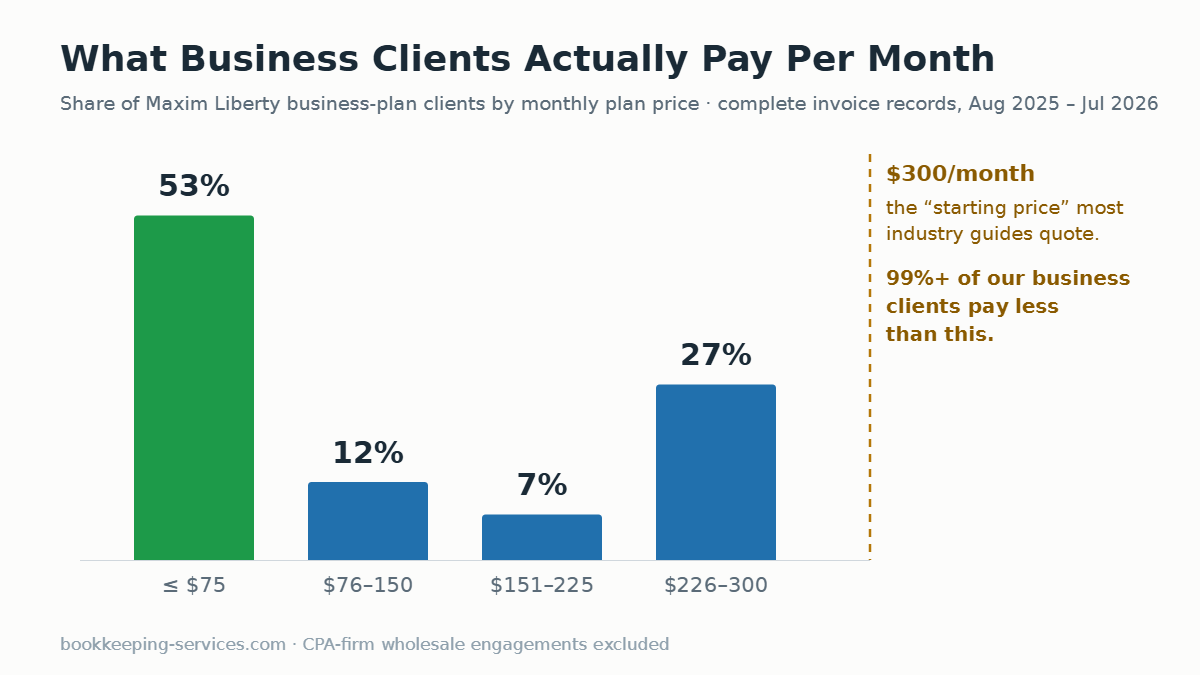
Most published cost guides quote each other. We analyzed our complete invoice records for business-plan clients from August 2025 through July 2026. Here is what actual billing shows:
- 94% of clients on our 5-hour Standard business plan were billed at the plan minimum and nothing else — no overage hours at all across the entire 12 months. Median actual usage runs about 3.5 hours a month, and we publish the hours worked on every statement.
- More than half of all business-plan clients pay $75 a month or less.
- Over 99% of business-plan clients pay less than $300 a month — the figure most industry guides quote as the starting price for professional bookkeeping. (CPA-firm wholesale engagements are a separate service tier and are excluded from these figures.)
- What 5 hours covers: roughly 300 transactions per month, with daily transaction logging and monthly reconciliations — and no limits on the number of bank or credit card accounts.
- If your books ever need more than the included hours, overage is linear at $15/hour — there is no forced jump to a higher plan tier.
Why We Price on Hours — and Most Competitors Price on Your Revenue
Look closely at how the well-known bookkeeping services set your price. Per Forbes Advisor’s 2026 comparison and the vendors’ own published pricing, Pilot starts at “$99 (depending on expenses)” and Bookkeeper360’s $399 starting price “will depend on your company’s monthly expenses.” Bench and Xendoo tier similarly. In other words: your price is indexed to how much money moves through your business — an artificial ceiling on expenses, revenue, or account count — not to how much bookkeeping work your business actually creates.
Those are very different things. A business with $100,000/month in expenses made up of ten wire transfers generates almost no bookkeeping work. A business with $8,000/month across 600 Stripe micro-transactions generates a great deal. Expense-indexed pricing charges the first business more — because it can pay more, not because the work costs more. And when your revenue crosses the ceiling, your price jumps a full plan tier even if your transaction pattern never changed.
Hours are the only pricing unit that measures effort directly. Our plans are hour blocks (5, 10, or 20 hours per month), the hours are reported to you monthly, overage is metered at $15/hour rather than cliffed into a bigger plan — and as the billing data above shows, 94% of Standard-plan clients never exceed the minimum at all. See the full breakdown on our pricing page and our companion guide to bookkeeper hourly rates by state.
How Hourly Pricing Compares to Monthly Plans
Most cost questions come down to one comparison: what an hour of bookkeeping actually costs under each model. An employee’s wage is the usual starting point, but it is not what the work costs you — payroll taxes, benefits, paid time off and software seats all sit on top of it.
| Model | Typical hourly cost |
|---|---|
| In-house employee (median wage) | $23.66/hour — median for bookkeeping, accounting and auditing clerks (U.S. Bureau of Labor Statistics, May 2024 data; $49,210/year) |
| Independent / freelance bookkeeper | Bills above the employee wage, because the rate has to cover self-employment tax, downtime and overhead |
| Maxim Liberty — businesses | $15/hour, with a dedicated bookkeeper and a supervisor on every plan |
| Maxim Liberty — CPA firms (white-label) | $10/hour |
The wage figure above is a national median and moves considerably by state. For the full breakdown, see our data on median bookkeeper wages in all 50 states.
Table of Contents
- Factors Affecting Monthly Costs
- Comparing Full-Time and Part-Time Budgets
- Full-Time Costs: In-house vs. Outsourcing
- Part-Time Costs: In-house vs. Outsourcing
- The Financial Difference: Bookkeeping vs Accounting
- Common Billing Models
- Bookkeeping Cost Calculator
- Frequently Asked Questions
Factors Affecting Monthly Costs
The budget required for financial management can vary widely depending on several operational factors. Businesses should carefully evaluate these variables to understand what drives the final invoice and how to optimize for their specific needs.
1. Business Complexity & Transaction Volume
The complexity of a business’s financial transactions is one of the biggest determinants of cost. For example:
- Multiple revenue streams: A business with various sources of income (e.g., retail, services, subscriptions) requires more detailed ledger management than one with a single income stream.
- Industry-specific needs: Businesses in certain industries, such as real estate, construction, or non-profits, often have unique compliance requirements, such as managing escrow accounts or tracking grant funding.
- Transaction volume: Businesses in retail, e-commerce, or restaurants often have hundreds or thousands of small transactions per month, which increases the time required for reconciliation.
2. Geographic Location & Labor Markets
If you choose to hire locally, your geographic location will significantly dictate your baseline expenses. Hiring an employee in a major metropolitan area like New York or San Francisco will cost substantially more in salary than hiring in a rural market. To bypass these high local labor markets, many companies utilize outsourced bookkeeping to access fixed, wholesale labor regardless of their physical location. For a detailed breakdown of specific market wages and BLS data, see our state-by-state guide on bookkeeper hourly rates. If you want a predictable monthly price instead of hourly billing, our virtual bookkeeping services start at $75/month with a dedicated bookkeeper.
3. Scope & Additional Financial Tasks
The range of tasks you delegate will directly influence the overall monthly bill:
- Accounts Payable & Receivable: Managing outgoing payments to vendors and following up on late customer payments increases the monthly workload.
- Payroll Processing: Calculating wages, deducting taxes, and managing benefits requires specific expertise and adds to the baseline cost.
- Sales Tax Filing: If your business is required to collect and file sales tax, this must be calculated and submitted on a strict monthly or quarterly schedule.
4. Technology & Software Integration
The type of software your team uses can also affect costs. While cloud-based platforms like QuickBooks Online and Xero automate many tasks, industry-specific software in fields like construction (Sage 300 CRE) or property management (AppFolio, Buildium) require advanced knowledge, which may increase monthly fees due to the specialized skills needed.
For rental portfolios, our property management bookkeeping team handles trust accounting and owner statements in AppFolio, Buildium, or Yardi.
Comparing Full-Time and Part-Time Budgets
Deciding between full-time and part-time support depends on the size and complexity of your business. Businesses that require continuous daily oversight will generally require full-time capacity. However, outsourcing a full-time workload is almost always more affordable than hiring a part-time in-house employee. For a full walkthrough of how outsourcing works — process, costs, and ROI — see our complete guide to outsourced bookkeeping.
| Factor | Full-Time Financial Support | Part-Time Financial Support |
|---|---|---|
| In-house Budget | $4,500 – $5,500/mo | $1,500 – $2,000/mo |
| Outsourced Budget | $1,800/mo | $200 – $300/mo |
| Savings via Outsourcing | ~67% Savings | ~90% Savings |
| Payroll Taxes Required? | Yes (if in-house) | Depends on contractor status |
Full-Time Costs: In-house vs. Outsourcing
Full-time ledger management is typically only necessary for large enterprises that handle a massive volume of daily transactions. An in-house professional is your employee and on your payroll, working in your office daily. This means you pay them for 40 hours a week, even if there isn’t always enough work to fill the day.
Additionally, you must cover employer payroll taxes (7.45% for Social Security and Medicare), office space, health insurance, and training, which drives up overall expenses to upwards of $6,800+ per month.
By switching to an outsourced provider, businesses routinely reduce costs by up to 74% compared to traditional hiring.
| Description | Full-time In-House | Outsourced Firm | Savings |
|---|---|---|---|
| Monthly Base Salary (@ 40 hrs/week) | $4,500.00 | $1,800.00 | $2,700.00 |
| FICA Taxes (@ 7.45%) | $335.25 | $0.00 | $335.25 |
| Office Space & Equipment | $750.00 | $0.00 | $750.00 |
| Health Insurance & Benefits | $750.00 | $0.00 | $750.00 |
| Turnover & Management Headaches | $500.00 | $0.00 | $500.00 |
| TOTAL MONTHLY BUDGET | $6,835.25 | $1,800.00 | $5,035.25 |
Part-Time Costs: In-house vs. Outsourcing
Part-time support is ideal for businesses with a lower volume of transactions. An in-house part-time employee usually requires a minimum commitment of 16 hours per week on-site. A virtual firm operates remotely with fractional availability, sometimes requiring as few as 5 hours of labor monthly, making it highly cost-effective.
| Description | In-house Part-Time | Virtual Firm | Savings |
|---|---|---|---|
| Monthly Cost | $1,500 (min. 64 hrs/month) | $200 (min. 20 hrs/month) | $1,300 Savings |
| FICA Taxes (7.45%) | $111.75 | $0.00 | $111.75 Savings |
| Office Overhead | $300.00 | $0.00 | $300.00 Savings |
| TOTAL MONTHLY BUDGET | $2,011.75 | $200.00 | $1,811.75 (90% savings) |
The Financial Difference: Bookkeeping vs Accounting
Many business owners overspend by having an expensive CPA perform routine data entry or bank reconciliations. Because CPAs carry advanced degrees, pass rigorous licensing exams, and assume regulatory liability for tax filings, their fees are significantly higher.
The most cost-effective financial strategy is to utilize an outsourced firm to maintain the daily ledger at a fractional cost, and reserve your CPA strictly for high-value tax strategy and compliance. To understand the exact functional differences between these roles and when to hire each, read our complete guide on bookkeeping vs accounting.
Common Billing Models Explained
Not all providers bill the same way. Understanding these models helps you compare quotes accurately and avoid hidden fees.
Time-Based Billing
You pay strictly for the labor time spent. While this ensures you only pay for what you use, expenses can be unpredictable month-to-month if a freelance contractor works slowly, making cash flow planning more difficult.
Monthly Retainer (Fixed-Fee)
A flat monthly fee covers an agreed scope of services. This is the model used by most professional outsourced providers, offering predictable budgeting and typically including a set capacity of labor per month. Plans often tier by update frequency (monthly, weekly, or daily).
Value-Based or Tiered Packages
Bundled service tiers that include ledger management plus add-ons like historical cleanup, payroll, or tax preparation at a set price. For an exact breakdown of how this model is structured to scale with your business, view our bookkeeping pricing plans.
Bookkeeping Cost Calculator
Use the calculator below to estimate how much your business will spend annually on in-house staff compared to the massive savings generated by utilizing an outsourced firm.
Annual Budget Calculator
Frequently Asked Questions About Budgets & Fees
How much should I budget for bookkeeping?
Your budget depends on your delivery model. A basic fractional outsourced plan starts at $75 per month for small businesses. Hiring a full-time, in-house employee will typically require an annual budget of $45,000 to $65,000+ when accounting for salary, benefits, and office overhead.
Is it cheaper to outsource or hire in-house?
Outsourcing is significantly cheaper. An in-house hire costs thousands per month in salary plus employer taxes and software seats. By utilizing a fractional outsourced team, businesses typically save 40% to 74% compared to full-time hires, as you only pay for the exact transactional volume required.
What factors increase my monthly fees?
Key factors that increase monthly fees include the number of monthly transactions, managing multiple bank and credit card accounts, complex payroll processing requirements, and the need for daily reconciliation versus standard monthly updates.
What is the average monthly cost for a small business?
The average monthly cost ranges from $200 to $2,500 depending on transaction volume. However, by utilizing fractional outsourced models, most small businesses effectively manage their ledgers for between $150 and $500 per month.
Is $75/month bookkeeping realistic, or a teaser rate?
It is realistic: our invoice records for August 2025 through July 2026 show 94% of clients on our 5-hour Standard business plan were billed at the plan minimum and nothing else, and the median client actually used about 3.5 hours. Five hours covers roughly 300 transactions per month with no limit on the number of accounts.What does 5 hours of monthly bookkeeping cover?
For a typical small business, about 300 transactions per month: daily transaction logging, categorization to your chart of accounts, and monthly bank and credit card reconciliations across unlimited accounts. Businesses that need more pay a linear $15/hour — not a forced plan upgrade.Conclusion
Understanding the actual expenses associated with financial management is essential for protecting your profit margins. Before hiring a local firm or an expensive in-house employee, evaluate whether an elastic, fractional service is the better fit for your bottom line.
Ready to Cut Your Operational Costs?
Get dedicated support from $75/month with a 100% money-back guarantee on 1st retainer, refundable on the unused balance. No setup fees, no lock-in contracts.